
July 2016 – silverfox175

After we returned to Broome from the oyster farm we decided to visit Cable Beach to witness the sun setting over the Indian ocean. We arrived about an hour before sunset because we wanted to enjoy a drink and the atmosphere. Living in Sydney we can see the sunrise, but the sun always sets over the land and a setting sea sun has such an appeal.
Cable Beach is named because it is where the telegraph cable from Singapore, via Java, came ashore in Western Australia in 1889.
The UK wanted the Empire connected, and the first cable connecting the UK & Australia came ashore in Darwin in 1872. Frequent breaks of the cable between Java & Darwin, due to volcanic activity in the Timor Sea, caused an additional cable to be laid away from the volcanic area – and Broome was the choice.

The sun is getting low

The beach attendance is thinning and the shadows are lengthening.

The restaurant / bar behind us is filling as people get ready for the setting.

Shadows getting longer . . .
 It’s started with the mushroom affect.

It appears to be setting this side of the horizon.
 I used a zoom to see what would happen – not much.

Using a small camera doesn’t do the colours justice.

It’s leaving us for another day.


Time for home, and the only thing missing are red sails in the sunset.

As we finished the tour of the oyster farm I asked Maureen if she would like a short flight in a helicopter. I’d flown in a helicopter across Sydney harbour some years ago in a traffic spotter helicopter for one of the Sydney radio stations. The weather had been horrible.
In Broome the weather was wonderful and Maureen had never flown in a helicopter.
The picture shows that the helicopter was little bigger than a toy! It held a maximum of four people, which included the pilot. He required our weight to work out his ‘load and balance’.
As we boarded (Maureen in the back), the pilot commented that he had to take the front door off because it had been cracked earlier in the day . . . . the seat without a door was mine.
 We were soon airborne

I took the above shot of the sand bank from the oyster tour boat about forty minutes earlier. The sand bar had nearly closed the creek / river entrance.

We flew over the same spot and as you see the sandbar has nearly gone and the river opening is much wider. You can see the sandbar just under the water and the black dot in the middle of the water is the oyster boat that we were alongside.

The moored oyster boat is just below us.

This is the end of Cable Beach, which originates in Broome twenty two kilometres south of us along the coast. Some people have tried to drive along the sand from Broome to the oyster farm (which is feasible) but inexperienced drivers failed to take in to account the speed of the incoming tide and the rise and fall of 9.5 mtr or 31 feet. They became stranded and lost their vehicles.

A general view of the surrounding area.

The dirt road that we used to get to the oyster farm, and the change in colour from the red soil to the dry sandy area, which is open the sea at certain times of the year – wet season and Equinox tides.
 Flying over the dry sandy area and the shadow of our helicopter.

Maureen in the back seat of the helicopter (what looks like a large knife at first glance is the seat strap). I just pointed the camera over my head a clicked blind – I was unable to turn around as the other hand was hanging on to my seatbelt, because of the lack of door. Every time we banked left I gripped the seat as I could feel gravity trying to drop me out of the machine. . . .

Blue Sky and Deep Blue Sea

The oyster farm that we visited.

Heading back to the farm – the white shoe on the left and the knee is mine, just to show how limited the space was in the helicopter.
Regardless of space – we loved the whole trip!
Come fly with me
While in Broome we took the opportunity to visit Willie Creek Pearl Farm, which was a fascinating time and very educational. It seems that ‘natural’ salt water pearls are no longer available, and all the pearls that we see are ‘cultured’ if they are the salt water variety. Fresh water pearls are imported mainly from China.
A small bus picked us up at 7.50 am for the 38 km (an hour’s drive) drive to the farm, which is outside the town of Broome.
It wasn’t long before we left the sealed road for the dirt road for the ‘bush’ trip to the farm. Most of the way to the farm seemed to be via the dirt road.


I loved the way the driver zig zaged to try and miss the bumps and the teeth shattering ‘corrugated’ parts. The ‘corrugated’ parts being created by the rainy season and baked rock hard by the sun, rather than man made metal.

Road junction – didn’t require traffic lights or pedestrian crossing.

As we drew closer to the shore the sand started to get lighter.

Over the rise and we were in a ‘river’ bed, which floods during the rainy season and during the equinox high tides.

The farm is just beyond the salt bush trees.
 A marine biologist gave us a very interesting talk on oysters . . . .
The oyster above is an oyster with a disease and was dead as he opened the two shells to show us the inside. Nothing is wasted – the meat is exported to Asia, as is the shell. Up to the mid 50’s most buttons were made from mother of pearl i.e the inside shell of an oyster and Broome supplied most of the global raw materials for buttons. In the 1950’s plastic buttons replaced the traditional shell buttons and the industry collapsed.
To create a pearl a specialist opens a live oyster and places a small piece of Mississippi mussel in to the oysters gonard. Over time this irritant is covered by nacre (a slimy solution, showing white at the bottom of the shell) by the oyster to protect itself. After the operation the oyster is returned to a special area to recover (the oyster can be left out of the water for about eight hours without any ill effects.) It is placed in special nets and hung two metres below sea level in tidal water. They feed from nutrients in the water as the tide rises and falls. The oysters are cleaned regularly and checked for disease, and they are rotated so that the nacre coats the pearl area in an even regular way, which produces a round pearl. If it was left alone gravity would cause the pearl to grow ‘flatter’ at one end.

 As the talk went on the speaker took a small tool and gently looked to see if this oyster had a pearl -he did not go ‘digging’, even though the oyster was dead.

I could see something and clicked away like mad.

It was a peal

The average peal can take two years to be produced, after which the oyster is opened and examined by a specialist, and if he thinks the oyster is in good health he will place the oyster back in the holding nets for another two years, after which he will check the pearl again for size and condition. Sometime he will leave it for a further two years to gain a larger pearl. After this talk, and realising the skill involved, I now know why pearls are so expensive.
 We took a boat trip out to one of the holding pens.
 The tide is coming in – note the level of the bank – the tide rises and falls 9.5 meters ( 31 feet) and the water is pristine.

The above pic is out of order (we are on our return), because we were only on the water a little over half an hour and you can see how high the water had risen in such a short time.

Below the surface the oyster nets hang from rope stretched between buoys.

We were shown an oyster that had been checked that morning only to be found that it had a disease on its outer shell. If not treated the disease would cause cracking in the shell, which would allow predators to get through the shell or the hinge and kill the oyster.
 The red area is the disease. This disease has been carried from over seas in contaminated fishing boats. The pearl industry has spent a great deal of time, energy and money looking for a ‘cure’ for the problem. They found it when they realised that if they increased the salinity this would kill the red disease without damaging the oyster. So by using swimming pool salt and rubbing it all over the out shell and then placing the oyster in a special brine over time the disease would die and not the oyster.

Oyster boat used to check the health of the oysters. The ‘hinge’ or join of the two shells to make a single oyster can become encrusted with sea creatures and the oyster farmer employs back packers to use a special tool to scrape the foreign matter from the hinge area. The back packers live on a mother ship and use the above boats for close work with the nets. They may be on the mother ship for three or four weeks, with the occasional run ashore. The act of scraping sounds a simple job, but we were told that within ten minutes the scraper’s arm starts to ache and it goes on aching for the rest of the day. I held the tool and it was quite heavy, and with actually dragging it along an encrusted oyster shell I could understand the arm ache.

At the end of the tour we were invited for tea and cake and Maureen met their tame crocodile.
Later we were shown around the ‘shop’ and given a talk on how to value pearls via the shape, size, colour and complexion. (SSCC) and the young man picked Maureen to were a particular string.

We were asked to guess the value of various pearls and necklaces. The above around Maureen’s neck had a value of just over $35,000. What a String of Pearls
Overall it was a great day out.
We arrived in Broome and checked in to Moonlight Bay Suites.
I booked our accommodation based on research, and with the help of Trip Advisor user’s comments.
Kate, the receptionist, could not do enough for us, with information and suggestions of things to do and experience.
 I didn’t see this view until the following morning.

As we entered our accommodation we were very pleased with the high standard of the facilities and the spaciousness.


The bathroom was through the the door on the right of our bed, which contained a bath and separate shower with good water pressure.
Our check in time was in the evening, so we were unable to see the surrounding gardens.
As dawn broke I had to try and capture the overall feeling of delight from our small balcony area.

The India Ocean can be seen in the distance and the green mangrove area in the centre of the picture, which appeared dry at the time . The swimming pool was not being used, but was available to residents during daylight hours.

I zoomed in on the area beyond the accommodation grounds. The lawn area is part of the accommodation and in the distance you can see the ocean – going out I think.

The day warmed to very comfortable 30 c – because of the very low humidity 30c is very pleasant.

 Lie in the pool or on a lounger and listen to the waterfall.

Later in the day the tide turned and returned to the edge of our accommodation’s garden. The hundreds of metres of sand had been covered by the daily nine and a half metre tidal change.
The accommodation is self catering, but as we leave each day we leave a card on the door for our rooms to be serviced. In most self catering accommodation we have been responsible for keeping the place clean and making our own beds, but at Moonlight Bay they look after all these details to allow us to appreciate the surrounding area.
Perth mint, which until 1970 was part or the Royal Mint of Britain. In 1970 ownership passed to western Australia.
On our recent visit to Perth we took a tour of the old mint. The ‘Mint’ in the city of Perth is now mainly a museum with the ability to sell and market coins etc. The ‘real’ mint is near the airport and under very tight security.

During the tour I had the opportunity of being weighed to find out how much I was worth in today’s dollars. If only . . . .
As part of the tour we watched the pouring of gold to create an ingot. The lights were switched off so as to see the pouring in a more dramatic way.

The furnace was opened to extract the container that contained the gold.

Wearing protective clothing the worker withdrew the gold container. This is how it used to be for many years.

The light on the left is the start of the gold leaving the container and being poured in to a mold.

The flow of gold has started.


The pour is complete in to the ingot mold, which is then thrust in to a bath of water to cool the block quickly.


Within minutes the ingot is cool enough to be handled, but only by the operator. We were not allowed anywhere near the gold :-o)

More of the real stuff. . . .

We also saw the above coin, which has a legal currency value of $1,000,000 – but it weighs 1,000 kilos and the gold value (as against the currency value) is in excess of $60,000,000.
In addition to the above we saw a million dollar coin with a gem stone embedded in the paws of a kangaroo. There is only one of these & I believe it has been sold to someone in Dubai.
 It weighs one kilogram and has a 0.54 carat gemstone
Just a few pics of ground level in Perth.
 I told you that kangaroos roamed the streets of Perth!

A touch of the old country – London Court

Bell Tower over looking the Swan River – a gift from the UK.
Twelve of the bells are from St Martin’s – in- the- Fields London, and a further five bells, which were casted in 1988 to celebrate the bicentenary of Australia – two being gifted by the City of London and the city of Westminster (one each), and the other three by British and Australian mining companies. A sixth bell was added by the West Australian Government to mark the second Millennium, which makes the ringing of the eighteen bells in Perth’s bell tower the largest secular bell tower in the world.

I tried to find out what this piece of art was all about , but it was fenced off . . .
 Business men through the ages going back in time . .


The ‘looped’ bridge that we saw from the restaurant.

Perth from the ‘Looped’ bridge.

A walk along the river bank to see the birds drying themselves in the sun.


Trees along the river bank – a beautiful spot.
While in Perth we arranged to meet our friends for lunch, and they were kind enough to book a table for four at C Restaurant on the 33rd floor of one of the city’s taller buildings. It was a revolving restaurant and it must be nearly thirty years since Maureen and I had eaten in a revolving restaurant – the last time being in Sydney – Sydney Tower.

We arrived just on noon, after a fast ride in the lift.
Our reception was very pleasant and the staff friendly and helpful – and one particular waiter was very entertaining.

We are off and running – the Swan River below.
 Part of the city framed.

The Swan again – the circus below is the same one that we could see from our bedroom window.

Government House below.
 Government House from street level.

I never got tired of the view of the river.


Later in the afternoon Maureen I walked across the bridge that can be seen with the two ‘loops’.

I had to take this picture, which shows the Bankwest building reflecting the image of a mining company building on my left, but out of camera view.

Besides meeting our friends, the point of lunch time was for a meal. Lovely food, well presented and not too expensive considering locations etc.
A few days away from Sydney in an effort keep warm – Perth is the transit stop to Broome, which is a two hour flight north of Perth. I can’t blame Perth for its coolness of weather nor could I complain about our hotel – Novotel. Using Accor points we secured a large corner room on the third floor.
As we moved along the corridor to our room I had concerns that it would not be what I’d hoped. We passed two blank service doors before we reached our room and entered – what a pleasant surprise!
A large bedroom containing two armchairs around a coffee table, a work desk, large TV and the normal fridge. In the corner was a walk in wardrobe area. The bathroom contained a Jacuzzi!


Two sets of windows gave us some great views across the Swan river 

Couldn’t have asked for better,
and they had an Irish Bar

For those readers in the UK, when the lady behind the bar (not shown) spoke to us, I asked if she was from Merseyside, because she had a definite ‘twang’. It turned out that she was from Chester and was on a working holiday. Talk about a small world.
The other odd thing was that one of the assistant managers spoke to us with a strong Irish accent. Only later did I find out that he was French, the hotel being in the Accor group, which is a French company. First time I heard the blarney from a Frenchman. :-o)
I know that we are supposed to plan for the future, and that the only sure thing is death and taxes.
During our Australian road trip last year I came across a grave . . . .
The ‘problem’ with this grave is that fortunately it is empty – at the moment!
It appears that the grave owner has started to carve his own epitaph on the head stone because (so I was told) he doesn’t trust his relatives to spend the money to mark his grave properly.
Over the years he has saved his cash and added a little every so often to his head stone.
As you see it is still unfinished.

Currently empty, so I have been told.

I am not sure I would like to invest in the future in the same way as Mr Gray.
Phnom Penh, Cambodia
Tuol Svay Prey High School or is it . . . .


Look closer and you might see barbed wire . .

The above picture was taken in side the ‘school’ grounds.


Cells for the prisoners.


How small is each cell


From an exercise pole to a pole of torture.
There are many photographs of those who were killed on display, but I didn’t think it was right to post them on a blog, particularly after read the regulations below.

The happiest moment of our visit came about as we were leaving. Near the exit gate I met one of the survivors of this horrible place.

Bou Meng had written about his time as a prisoner.
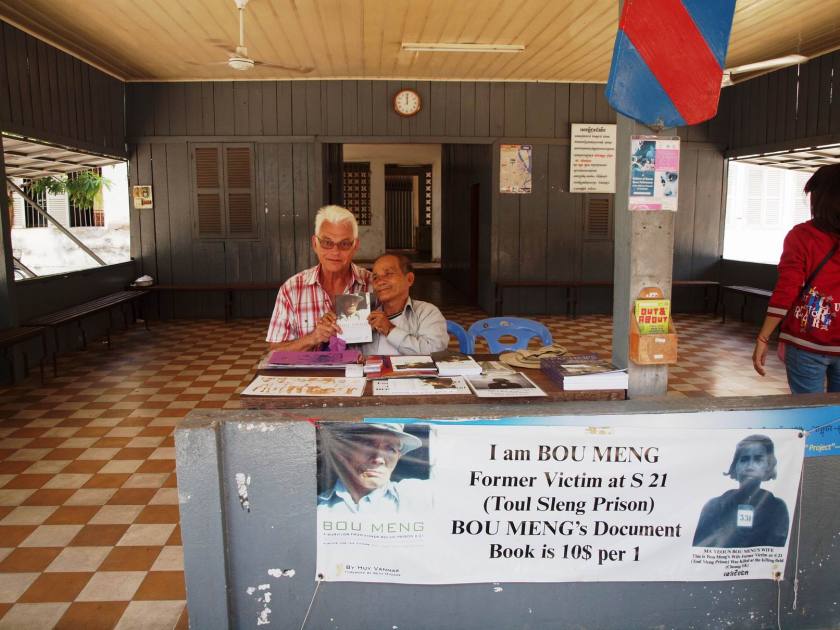
I felt honoured that he was happy to sign his book for me.
This ‘school’ is located in the capital city, it is not hidden away.
It was only a short drive and we were happy to see how life had changed for the locals.
